About the Union
Keeping faith with a school founded in 1845
The Old Boys Union brings together the former pupils of the Sierra Leone Grammar School — the Regentonians — to serve the school, support one another and carry its values into the world.
A message from the President
“Every one of us was given something at Murray Town that we could never repay in full. Our task is to make sure the boys who come after us receive at least as much.”
Dear fellow Regentonians,
For more than 180 years the Sierra Leone Grammar School has formed young men of learning, faith and character, who have gone on to serve Sierra Leone and the wider world. Each of us carries something of the school with us — in the way we work, the way we lead and the way we treat others. Διώκω: we press on.
The Old Boys Union exists so that this inheritance is never taken for granted. Through our chapters at home and across the diaspora, and through the dedicated work of the Improvement Committee, we stand behind the Principal, the staff and the boys who wear the purple today.
This year our great task is the renovation of the school’s Physics, Chemistry and Biology laboratories. Science is where so many of tomorrow’s doctors, engineers and innovators will discover their calling — but they cannot learn practical science without safe, working laboratories. I ask every Old Boy, every set and every chapter to give what you can, and to join us at the Annual Dinner & Dance on 20 November, where every ticket goes straight to the laboratories.
If you have drifted away from the Union, this is the moment to come home. Register as a member, pay your dues, find your chapter, and bring a classmate with you. Together we build, together we support, and together we excel.
God bless our Grammar School.
Willie L. Dinkin-Koroma
President, SLGS Old Boys Union
Our mission
Serving the school that shaped us
The Union is the association of Old Boys of the Sierra Leone Grammar School in Sierra Leone. Through its members, its chapters and its Improvement Committee, it raises funds for the school’s buildings and facilities, mentors its pupils, and keeps alive the fellowship that begins on the first day at Murray Town.
We share the school’s own mission: to promote responsible citizenship through quality education and sound moral values, so that every boy can make the most of his potential for learning and excellent service.
Our motto: “To pursue”
The Greek word St Paul uses in Philippians 3:14 — “I press toward the mark”. Regentonians are known for their dogged determination in the pursuit of goals.
Our objectives
- Promote the welfare, development and good name of the Sierra Leone Grammar School.
- Unite Old Boys of every set, at home and abroad, in fellowship and service.
- Raise and manage funds transparently, through the Improvement Committee, for agreed school projects.
- Support pupils through mentoring, careers guidance, prizes and scholarships.
- Uphold the Christian ethos and the traditions on which the school was founded.
Our history
From Regent Square to Murray Town
Why are we called Regentonians? Because the school began life in the “house of arches” on Regent Square — a building that still stands. The square gave us our name; the school gave us our character.
-
1799
The Church Missionary Society
Abolitionists including William Wilberforce and Henry Thornton found the “Society for Missions to Africa and the East” — later the Church Missionary Society. Its first missionaries reach Africa in 1804.
-
1816–1827
The Christian Institution
The CMS opens a Christian Institution at Leicester, near Freetown, with about 350 children. It moves to Regent and is abandoned in 1826; in 1827 the Rev. Haensel revives it at Fourah Bay — the beginning of Fourah Bay College.
-
1845
The Grammar School opens
As Fourah Bay College’s standards rise, the CMS creates a school to prepare boys for it. Fourteen junior students of the College move to the “house of arches” on Regent Square — the Governor’s residence until 1841 — rented from the colonial government for two shillings and sixpence a year. The Rev. Thomas Peyton is the first Principal.
-
1849–1850
A school for West Africa
By 1849 pupils come from across the West African sub-region, and by the end of 1850 there are fifty-five scholars. For twenty years it is the only secondary school in West Africa.
-
1850s
Training the teachers
The school divides into a teacher-training section and a section preparing boys for Fourah Bay College. In 1859 it becomes the model for the CMS Grammar School in Lagos.
-
1863
The band is founded
Under Principal James Quaker — one of the fourteen foundation pupils — the school band is born. It later grows into the famous brass and reed band.
-
1871
A press of its own
Principal Quaker starts a printing press, taught by Mr James Millar of Waterloo. Two years later it produces The Ethiopia, a twice-monthly newspaper edited by the Principal — the school’s own voice for African aspirations.
-
1908
Scouting comes to Sierra Leone
Principal G. G. Garrett starts the Boy Scout movement at the school, only a year after Baden-Powell began it in England — the first Scouts in Sierra Leone.
-
1962
A new home at Murray Town
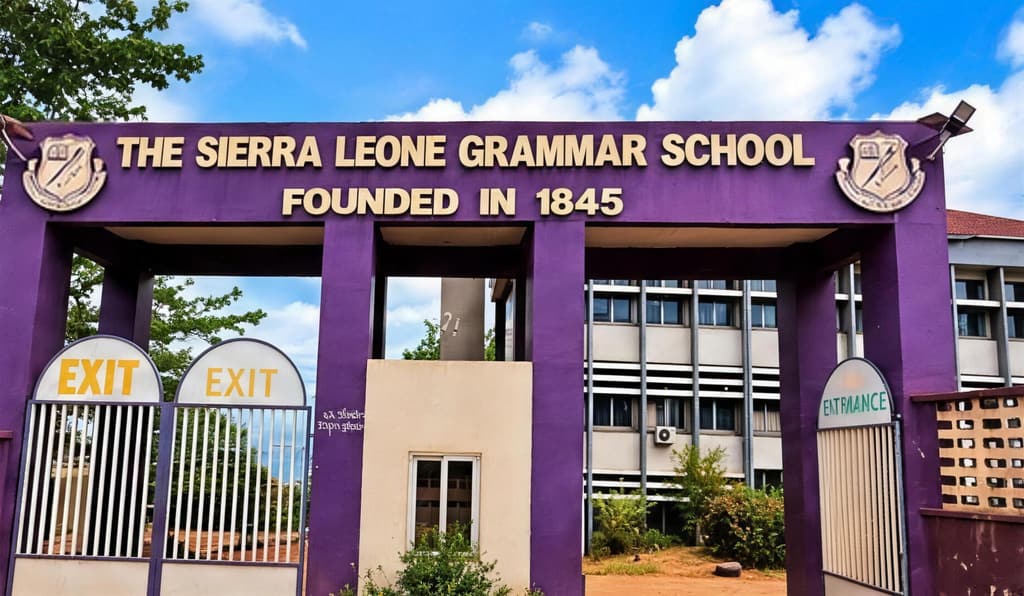
The school moves to its present campus of some fifty acres at Murray Town, a short walk from the sea, behind its purple gates.
-
2007
Independence regained
In September the school regains its independent status, governed under the Anglican Diocese of Freetown as successor to the CMS.
-
Today
A global family
Regentonians organise in Freetown, the United Kingdom and North America. The Old Boys Union and its Improvement Committee lead support for the school at home.
25 March 1845
The fourteen foundation pupils
The school opened with fourteen junior students transferred from Fourah Bay College. Their names and home towns are recorded — from Freetown, the villages of the Colony and the interior.
- The Gallinas
- Two sons of a ruler of the Gallinas, surnamed Gomez
- Three boys freed from a slave ship by an anti-slavery schooner
- Kissy
- Joseph Flyn
- Charles Macauley
- Charles Nelson
- Kent
- James Quaker
- Thomas Smith
- Freetown
- Daniel Carol
- Fourah Bay
- Robert Cross — a man of thirty when he enrolled
- Port Loko
- Frederick Karli
Thirteen of the fourteen are accounted for in the record; the fourteenth is not named. Can you help?
What they studied
From the first day, a demanding grammar-school course:
- English grammar & composition
- Greek
- Mathematics
- Geography
- Bible history
- Astronomy
- Doctrine
- English history
- Writing
- Music
Latin was later added as a voluntary subject, followed by Euclid and algebra.
The Grammar School set the tone for secondary education throughout Sierra Leone and West Africa.
A legacy of firsts
-
Secondary education
For twenty years the only secondary school in West Africa, it set the tone for secondary education across the region.
-
Teacher training
From the 1850s it trained the teachers who carried education into the colony and beyond.
-
A free press
With its own press and The Ethiopia, it pioneered one of the pillars of democracy: a vibrant press.
-
National integration
Six of the foundation pupils — 43% — came from what became the Provinces, drawing the whole country together from the start.
-
Scouting
It brought the Boy Scout movement to Sierra Leone in 1908.
Sources: Prof. C. Magbaily Fyle, “The Grammar School and Education in Sierra Leone” and A History of the Sierra Leone Grammar School (1845–2015); slgs.edu.sl.
The school song
Regentonia
Words by the Rev. G. G. Garrett, M.A., Principal from 1906 to 1912. Sung wherever Regentonians gather, at home and abroad.
Verse 1
On the western side of Freetown upon an ancient siteWhere a great and massive building stands a witness to the lightThere lives a band of comrades true a band that’s ne’er been sentSince the fathers to the old boys gave the glorious name Regent.
Chorus — after each verse
Live forever, sundered never, faltering never, grammar schoolLive forever, sundered never, Regentonian true schoolSchool, school, school, school, schoolGod bless our grammar school.
Verse 2
When the Old Boys rally round us and tell of what has beenThey may urge us to more study they must meet us on the greenTo our well-loved alma-mater we every one shall clingAnd year by year in deeper tones more fervently shall sing.
Verse 3
When we’re marching home in glory and we’ve beaten them six nilOr the telegraph’s a hundred up and the captains batting stillWhen the flag flies for a triumph that the good old school has wonThen gladly let the chorus rise and sound it every one.
Verse 4
Oh! Tis not the nerve or sinew or learning store aloneThat the school upon her sons bestow which stamps them for her ownTis manhood’s gleams in boyish eyes steadfast and true and keenA heart that never quailed at need: the soul that ne’er was mean.
Our values
What every Regentonian carries
-
Excellence
In learning and in life — the standard every Regentonian carries.
-
Integrity
In character and in service, at home and wherever we settle.
-
Responsibility
To our school, to society and to the nation of Sierra Leone.
-
Heritage
A global Regentonian community bound by a shared story since 1845.
Notable old boys
Regentonians who shaped West Africa
A few of the many who passed through the school and went on to lead in government, law, medicine, scholarship and the arts.
-
Charles D. B. King
17th President of Liberia
-
Sir Samuel Lewis
First West African to be knighted; Mayor of Freetown
-
James Africanus Beale Horton
Army surgeon, scientist and political writer
-
Sir Ernest Beoku-Betts
Mayor of Freetown and judge
-
Prof. Eldred D. Jones
Literary scholar; Principal of Fourah Bay College
-
Nicholas G. J. Ballanta
Composer and musicologist
-
Modjaben Dowuona
First Registrar of the University of Ghana
-
Lamina Sankoh
Educator and co-founder of the People’s Party
Leadership
The National Executive
Elected by financial members at the Annual General Meeting to lead the Union’s work.
-
Willie L. Dinkin-Koroma
President
-
Victor Kwame Barber-Richards
Vice President
-
Patrick Fofanah
Secretary General
-
Adeyemi Jarrett
Assistant Secretary General
-
Simeon Cole
Social & Organising Secretary
-
Charles Hycy-Bull
Assistant Social & Organising Secretary